
In my last letter, I told you about Hugh, the invisible threads he created, and his pursuit of possibilities. What I did not tell you much about was what happened to The Great Discontent after he was gone.
For a while, the answer was: very little.
There were practical reasons for that. There were people and businesses to take care of, and grief has a way of rearranging what feels urgent. But there was another reason we left the magazine alone.
We didn’t know what it meant to bring it back without Hugh. Finishing an issue is one thing. Carrying the work forward is another.
The longer we sat with it, the less interested we became in simply restarting what had stopped. Three years is a long time. We are different. We have changed.
When The Great Discontent began fifteen years ago, many of its conversations were with people whose names you may already know: designers, photographers, filmmakers, artists, and founders doing remarkable work. I am proud that those stories are part of the magazine’s history.
But over time, and especially under Hugh’s stewardship, our attention began to shift.
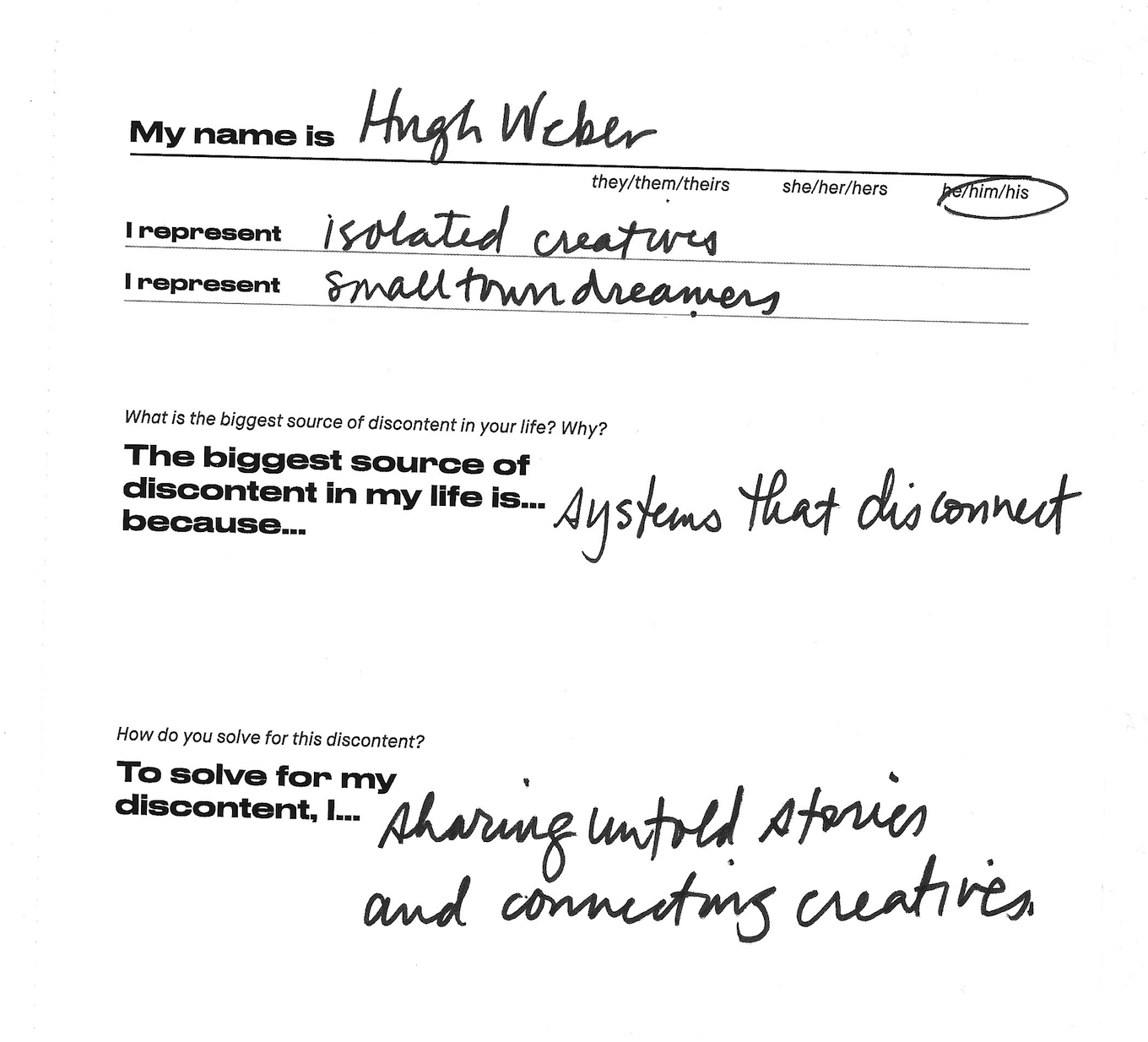
Hugh was interested in the people who were easier to miss. The creatives making something important in a small town. The emerging designer using their work to make a positive impact.
The person whose name may never appear on an awards list, but whose work is changing the lives of the people around them.
He was less interested in asking, “Who is successful?” and more interested in asking:
Who should we be paying attention to?
That distinction matters even more to me now.
There have never been more ways to find creative work. There has also never been more demand to make that work shorter, louder, faster, and easier to measure. People become follower counts jammed between an ad and a video you forget minutes later.
I don’t believe The Great Discontent needs to compete with that.
In fact, I think our work may be to oppose it.
To spend more time with fewer people. To ask questions that cannot be answered in a caption or by an AI bot. To make something that does not disappear because you closed a tab. And to keep looking for people whose work deserves to be seen.
That has led us to one decision we are ready to share with you now.
The Great Discontent is returning to print.
And only to print.
Not because we think the internet is bad. Not because we are trying to recreate 2012. And not because a printed magazine is somehow more virtuous than a website. We are returning to print because the physical magazine changes the way we make it.
It forces us to choose.
Every story asks us to decide what deserves our time, our attention, and a permanent place on the page.
Once it is printed, you cannot update it, optimize it, or make it perform better.
You have to decide that something is worth putting into the world and then stand behind it.
I like that constraint.
I also love what happens on the other side of it.
I love the idea of creating a publication that can sit on a coffee table for ten years. That can be handed to a friend. Left in a studio. Put in a community library. Discovered by a kid in a town where nobody around them does the kind of work they dream about doing.
As someone who thrived in the realm of possibility, Hugh understood that last part particularly well.
It is why he set aside more than a thousand copies of The Great Discontent for HBCUs and rural colleges. He understood the contradiction in making a beautiful printed object: the people who might be most changed by it are not always the people with the easiest access to it.
We have been thinking a lot about that too.
Because we don’t just want to put The Great Discontent back into print.
We want to put it back into circulation.
Into homes and studios, yes. But also into classrooms, libraries, colleges, and places where someone might encounter a story that gives them permission to imagine the possibilities.
That part of Hugh’s work is not finished. Neither is the magazine he left behind.
This past week, there was a strange reminder of all of this for us.
A few hours after we posted our first letter, our Instagram account was hacked. An account that organically grew over years, with more than 45,000 people following along, disappeared from our hands almost overnight.
We are working to get it back. I hope we do.
But there was something clarifying about losing access to a place where you thought your community lived.
Because you are still here.
You wrote back to the first letter. You forwarded it. You told us stories about Hugh and about what this magazine has meant to you.
The account disappeared. You did not.
Maybe that is another kind of invisible thread.
And it has made me even more certain that whatever we build next should not depend entirely on an algorithm, a feed, or a platform that can disappear overnight.
In my next letter, I am going to show you what we intend to do with both.
I will share what happens to the unfinished issue. What comes after it, how we are thinking about making sure this publication reaches people who might never buy a copy for themselves.
And how you can be a part of it.
Not exactly as it was.
As what it was becoming.
Sheharazad
Editor in Chief
The Great Discontent